

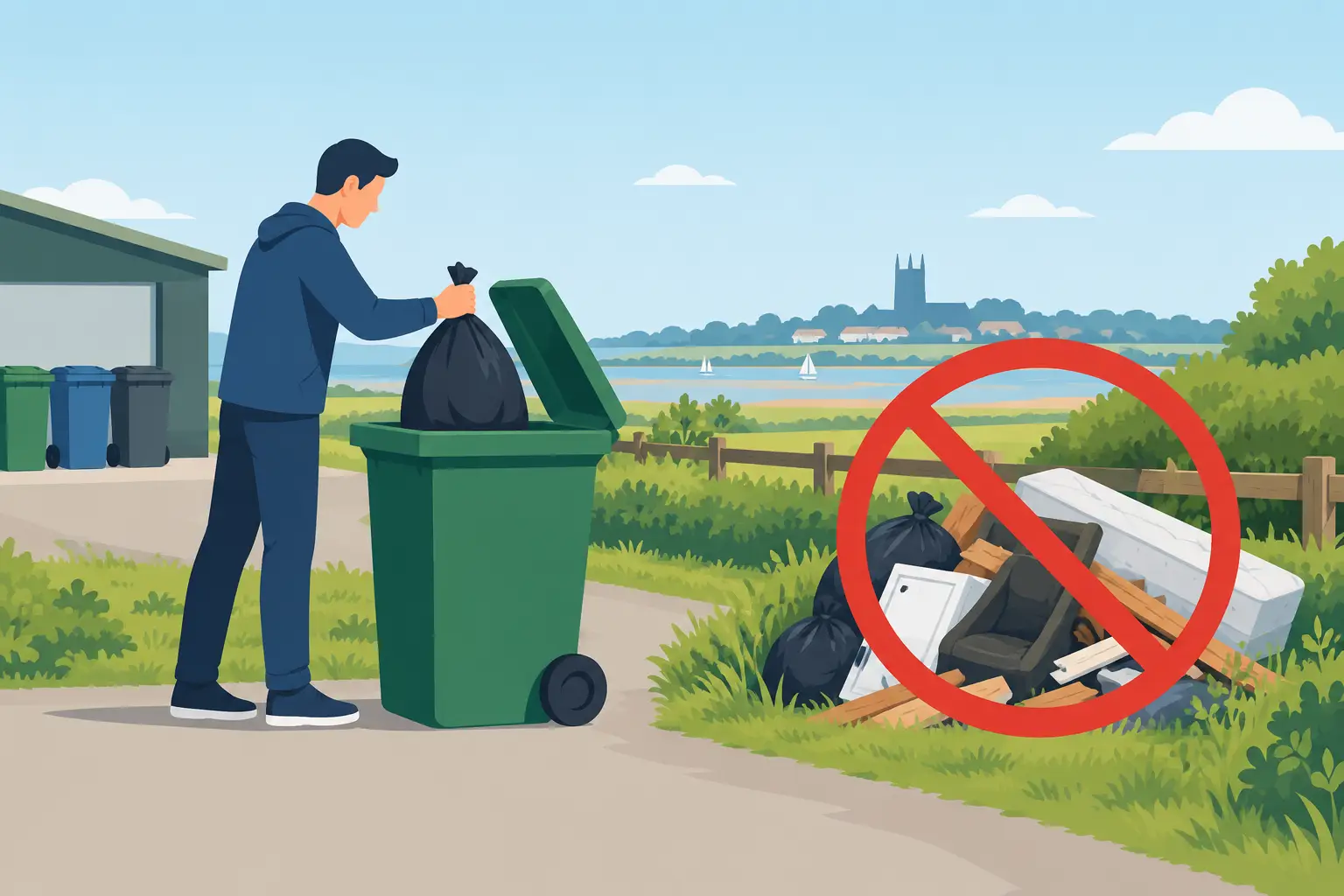
A black bag left beside a full bin, an old mattress put out too early, or a cheap ‘man with a van’ who disappears with your rubbish can all create trouble. To avoid fly tipping fines, you need to know where your waste is going and who is taking responsibility for it. For households across Sudbury, Colchester, Hadleigh, Ipswich and Bury St. Edmunds, the safest approach is usually the simplest: use a proper, licensed route and keep a record of it.
Fly tipping is not just someone dumping a sofa in a country lane. It can include leaving waste on public land, beside communal bins, in a lay-by, or outside somebody else’s property without permission. Even a small amount of rubbish can lead to enforcement action if it has been dumped illegally.
Many people assume the person who physically dumps the rubbish is the only one at fault. They are not always right. In England, households have a duty to take reasonable steps to make sure their waste is passed to someone authorised to carry it.
That matters when you hire a clearance service through a social media post, accept a knock at the door, or pay cash to someone offering a very cheap collection. If that person takes your bags, furniture or building waste and tips it elsewhere, the council may investigate where the waste came from. If you cannot show that you checked who was collecting it, you could face a fixed penalty notice or prosecution.
The size of any penalty depends on the circumstances and the local authority involved. Serious cases can be dealt with by the courts, where the consequences are far greater than the cost of arranging a legitimate collection in the first place. There is also the time and stress of answering questions, providing evidence and trying to prove you acted responsibly.
The practical rule is straightforward: never hand over rubbish until you are satisfied that the collector is legitimate. A professional waste carrier should be happy to provide their Environment Agency waste carrier registration details. You can check the registration on the public register before booking, particularly if you have not used the business before.
Price is a useful warning sign. Everyone wants a fair quote, but a price that seems far below every other local option can mean the collector has not allowed for lawful disposal. Responsible waste removal involves loading, transport, sorting and disposal costs. Those costs do not disappear simply because the quote is cheap.
Ask where the waste will go and what paperwork you will receive. For a household job, a written receipt or waste transfer note is useful evidence that you passed the rubbish to a named business on a particular date. Save the booking confirmation, invoice, text messages and payment record too. You may never need them, but they are worth keeping until you know the job has been completed properly.
A quick check before collection can prevent a costly mistake:
If a collector avoids basic questions, will only deal in cash, has no business details, or pressures you to decide immediately, find somebody else.
Putting waste outside your home is not a safe shortcut, even if you intend to deal with it later. Pavements, verges, shared access areas and spaces beside public bins are not temporary storage areas for unwanted furniture, bags or renovation debris.
This is especially relevant after a clear-out. A pile by the gate can quickly be added to by other people, pulled apart by animals or blown around in poor weather. What started as a few items waiting for collection can look like a fly tip by the time an enforcement officer or neighbour sees it.
If a collection is booked, keep the rubbish inside your boundary until the agreed collection time unless your collector has given clear instructions otherwise. Make sure it is on your own land and does not block a footpath, shared drive or road. If you live in a flat or use communal bins, check the rules with your managing agent or landlord before leaving bulky items in shared areas.
The best way to manage waste depends on how much you have, what it is and how quickly it needs to go. A few bags of household clutter and an old chair may suit a booked rubbish collection. A garden clear-out can produce more volume than expected, while shed contents or refurbishment waste may be better handled with a skip.
For a skip, think carefully about where it will sit. A skip kept on private land, such as a drive, will generally avoid the need for a highway permit. A skip placed on a road or verge may need permission from the relevant council, along with safety measures such as lights or markings. Do not assume you can place one outside your home simply because there is space there.
A driveway skip can be a convenient choice for jobs with a steady flow of waste, such as a kitchen refit or garden project. A collection is often better when access is tight, parking is limited, or you want everything removed in one visit. The right option is the one that keeps waste contained and removes the temptation to stack it outside for days.
Mixing the wrong materials into a collection or skip can cause delays and extra charges. More importantly, some items need specialist handling and should never be dumped or hidden among general rubbish.
Typical household and general waste may include unwanted furniture, cardboard, bagged rubbish, garden cuttings, wood, old shed contents and non-hazardous renovation debris. But items such as asbestos, gas bottles, paint, solvents, chemicals, tyres, batteries, electrical equipment and plasterboard can have separate disposal requirements. Soil and rubble may also need to be handled differently from general household waste.
Be honest about what you need removed when requesting a quote. A clear photo and a short description of the waste can help a local collector give the right advice before arriving. It is far easier to arrange the correct disposal route at the start than to discover prohibited materials once the vehicle or skip is on site.
Waste disputes often arise at the end of a tenancy or building job, when everyone assumes somebody else will deal with the final pile. Landlords should set out who is responsible for removing unwanted items and garden waste before a tenant moves out. Tenants should not leave furniture or bags beside bins unless the landlord, managing agent or council has confirmed that this is allowed.
If you are using a builder, gardener or handyman, ask whether their quote includes waste removal. If it does, ask for confirmation that they will use a licensed carrier. If it does not, arrange your own collection or skip rather than allowing waste to build up at the property.
This is not about making a simple job complicated. It is about avoiding the awkward situation where rubbish is left behind, a neighbour complains, and nobody can show who was meant to remove it.
A proper collection should feel uncomplicated. You explain what needs to go, receive a clear quote, agree a time, and the waste is removed by a licensed operator. Box Rubbish Removal provides domestic rubbish collections and skip hire for local households that want a fast, reliable way to clear general waste, garden rubbish, shed contents and renovation debris without leaving it at the kerb.
If you are unsure whether an item can be collected, ask before booking. A five-minute conversation can save a wasted journey and help make sure your waste is handled correctly.
The cheapest-looking option is rarely a bargain if it leaves your rubbish in a hedge, a lay-by or somebody else’s street. Keep your waste on your property, use a legitimate carrier, retain the paperwork and choose a collection method that suits the job. Then the clear-out is finished properly, and you can get on with enjoying the space you have made.

Do you need a reliable local rubbish clearance and/or skip hire company in Sudbury or Colchester? Then you’re in the right place.

